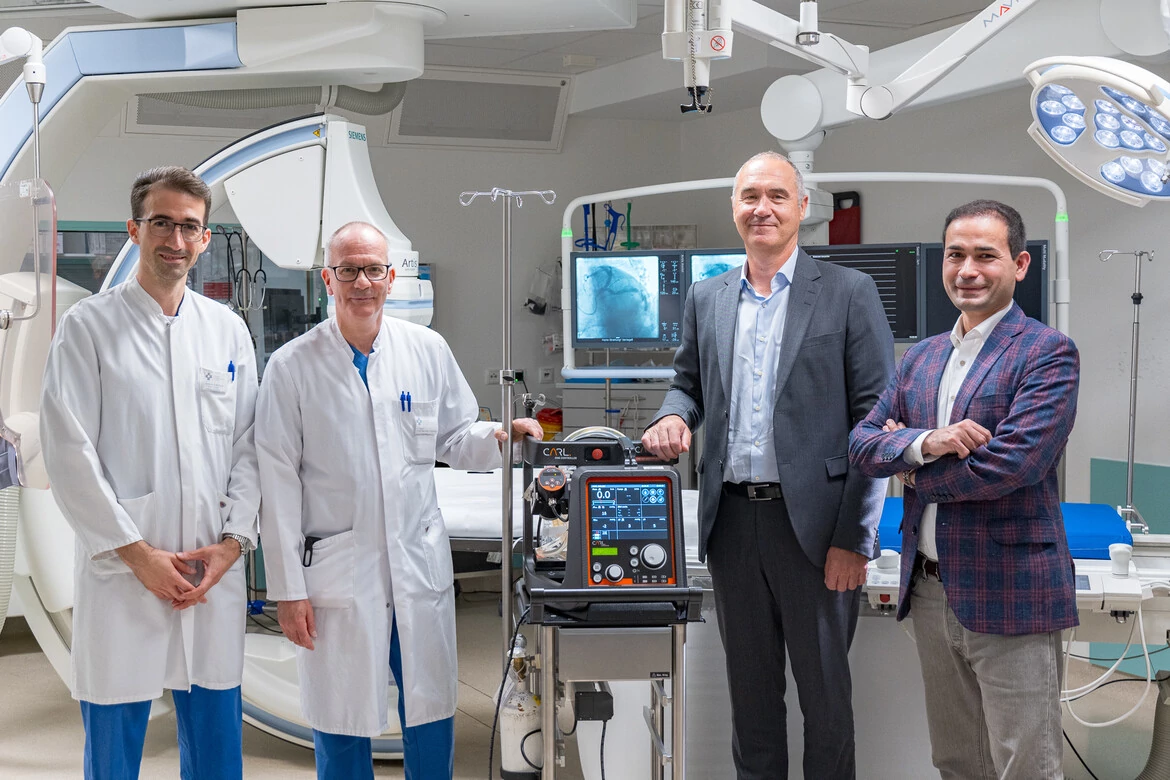
ECMO saves lives at St. Antonius Hospital in Kleve
2 September, 2025
On July 17, 2025, St. Antonius Hospital in Kleve used ECMO (extracorporeal membrane oxygenation) for the first time on a critically ill patient with acute cardiac arrest.
The CARL ONE Controller used works on the principle of a mobile heart-lung machine: in the event of circulatory shock, it can completely take over both the pumping function of the heart and the oxygen supply to the lungs.
The starting point
Until now, this highly specialized therapy was not available in the Kleve district. Affected patients could only be treated by a team from Düsseldorf University Hospital. The cardiac surgery department, headed by University Professor Artur Lichtenberg, has a mobile ECMO team that was called in for such cases. However, the necessary travel time regularly led to delays in starting this vital treatment.
Fast, targeted assistance
Since July of this year, the situation has improved significantly: St. Antonius Hospital now has its own mobile CARL ONE Controller, which can be used at any time by the cardiology department headed by Dr. Norbert Bayer. In acute shock situations, this life-saving measure is now immediately available. “The patient is doing well under the circumstances and is expected to receive a left ventricular assist device (LVAD) soon. The LVAD, colloquially known as an artificial heart, is a mechanical pump that supports the pumping function of the left ventricle in cases of advanced heart failure. This case impressively demonstrates how important the rapid availability of ECMO is for people in the local area.”
Life-saving cooperation
Once the patient has been stabilized, he can be transferred to Düsseldorf University Hospital under controlled conditions. Prof. Lichtenberg’s clinic is the second-largest heart transplant center in Germany. He particularly emphasizes the close coordination with Kleve: “The collaboration with Dr. Bayer’s team is not only excellent from a professional standpoint, but also characterized by a high level of trust. Together, we are able to stabilize critically ill patients at an early stage and provide them with optimal further treatment.”
The new technology also represents enormous progress for the region: “With the introduction of ECMO therapy at St. Antonius Hospital, we are closing an important gap in care. This was also one of my first measures in the Lower Rhine region,” says Sadık Taştan, spokesperson for the management board. “In acute emergencies, every second counts. Thanks to rapid availability on site, we can now offer our most seriously affected patients a significantly better chance of survival.” Thanks to his many years of experience and his previous position as managing director of the Sana Heart Center in Cottbus, he is already familiar with the procedure, which is why its immediate establishment immediately after he took up his post in mid-June was a matter close to his heart.
This innovation will significantly improve the care of shock patients in the Kleve district. The combination of technical equipment, medical expertise, and trusting, supraregional cooperation guarantees people in the region direct access to high-performance cardiovascular medicine.